StandardForward Am
* Affiliate-Link: Bei einem Kauf über diesen Link erhalten wir eine Provision – für dich entstehen keine Mehrkosten. Mehr erfahren
* Preise inkl. MwSt., zzgl. Versandkosten. Bei einem Kauf über diese Links erhalten wir eine Provision – für dich entstehen keine Mehrkosten. Letzte Aktualisierung vor kurzem.
Keine Preisdaten verfügbar
Noch keine Bewertungen
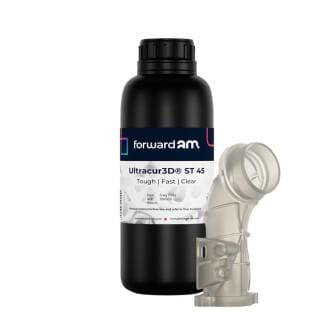
Ultracur3D ST (High impact product line) is a medium-viscosity, highly reactive photopolymer for stereolithography applications resulting in tough multi-purpose parts. It can be used to produce high-performance functional parts using stereolithography (SLA), digital light processing (DLP) or liquid crystal displays (LCD, or MSLA). Ultracur3D ST can meet the requirements of functional applications for high accuracy and mechanical strength where existing 3D printing materials often have limitations. ST 45 synthetic resin is available in three different variations. The material comes as standard in a transparent version without colour pigments. ST 45 B offers a black look, ST 45 M has been specially modified to be compatible with a wide range of 3D printers. For example, ST 45 M can also be used on devices that do not offer open parameters for printing. The safety data sheet of the material can of course be sent to you on request. ST 45 is used in various applications, for example in the automotive industry for airbags, ventilation covers and fittings. Due to its high surface quality, the resin is of course also suitable for everyday objects such as housing covers, connectors, brackets and fixtures, as well as for design prototypes. BASF is the world's largest chemical group with sales of 59.3 billion euros (2019). Founded in Mannheim in 1865, the company now has over 115,000 employees and its headquarters is in Ludwigshafen on the Rhine. All 3D printing materials produced by BASF Forward AM are manufactured within the EU.
Harz-TypBestimmt den Hauptanwendungsbereich und die mechanischen Eigenschaften des ausgehärteten Harzes
Standard
WellenlängeMuss zum UV-Licht deines Druckers passen — 405nm ist am häufigsten
385 nm
ViskositätNiedriger = leichter zu gießen und abzuziehen. Höher = stärker, aber schwerer zu verarbeiten
350 mPa·s
SchichtdickeDünnere Schichten = mehr Details, aber längere Druckzeiten
25 - 100 µm
Härte (Shore)Höherer Wert = härteres/steiferes Teil. A-Skala für flexibel, D-Skala für starr
Shore 80D
SchrumpfungWie stark das Teil nach dem Aushärten schrumpft. Weniger ist besser für Maßgenauigkeit
1.2%
DichteGewicht pro Volumen — beeinflusst das Endgewicht des Teils
1.12 g/cm³
GewichtNettogewicht der Flasche inklusive Harz
5 g