Back to Catalog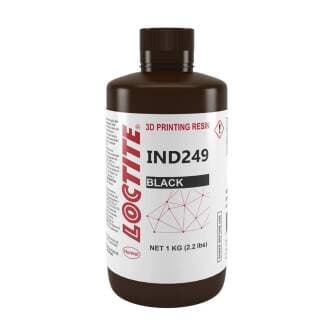 Tough/ABS-Like
Tough/ABS-LikeHenkel
Tough/ABS-LikeHenkel
LOCTITE, a brand of the German company Henkel, is recognized worldwide as a leader in adhesives, sealants, and surface treatments. Its groundbreaking technologies offer first-class solutions that deliver durable, high-performance, and consistent results. LOCTITE strives to provide efficient adhesives that unlock the full potential of people and machines. Loctite 3D IND249 is a material with high temperature resistance and high strength that precisely prints complex geometries with fine feature resolution. Thanks to its low viscosity, this material exhibits exceptionally high green strength, enabling trouble-free processing. Its stiffness and thermal resistance make Loctite 3D IND249 particularly suitable for production applications such as molding tools, manufacturing aids, and other complex geometries. Validated workflows are available to successfully print Loctite 3D IND249 on various DLP platforms. The advantages of this material include exceptionally high stiffness, low viscosity, high print accuracy, and good temperature resistance. This makes it ideal for use in demanding geometries, mold tooling, the manufacture of production aids, and other complex geometries. Printer Settings LOCTITE 3D IND249 BK has been specifically developed for use on industrial DLP printers. Careful reading of the Safety Data Sheet is recommended to obtain comprehensive information on health and safety guidelines. Recommended printing parameters: Cleaning To achieve the specified material properties of LOCTITE 3D IND249 BK, post-processing is required. Before final curing, the support structures should be removed from the printed part and the part should be cleaned. Compressed air can be used to remove residual solvents from the material surface between curing cycles. Post-curing To achieve the desired material properties of LOCTITE 3D IND249 BK, post-curing is necessary. It is recommended to use either LED lighting or a broadband radiation lamp for post-curing the parts. If a lower-energy LED or another post-curing unit is used, additional heat curing at 130°C for 2 hours may be required to achieve the highest HDT performance. The components should be allowed to rest for one hour between UV curing and heat curing. To minimize the risk of warping, it is recommended to place the components in a cold oven, then gradually increase the temperature to the target value, and slowly cool the components in the turned-off oven after the heat curing conditions have been reached.
Resin TypeDetermines the primary use case and mechanical properties of the cured resin
Tough/ABS-Like
WavelengthMust match your printer's UV light — 405nm is most common
385 nm
ViscosityLower = easier to pour and peel. Higher = stronger but harder to work with
350 mPa·s
Layer ThicknessThinner layers = more detail but longer print times
25 - 100 µm
Hardness (Shore)Higher number = harder/stiffer part. A-scale for flexible, D-scale for rigid
Shore 82D
ShrinkageHow much the part shrinks after curing. Lower is better for dimensional accuracy
1.5%
DensityWeight per volume — affects the final part weight
1.15 g/cm³
WeightNet weight of the bottle including resin
1 g
* Affiliate link: We may earn a commission if you purchase through this link – at no extra cost to you. Learn more
* Prices include VAT, plus shipping. We may earn a commission if you purchase through these links – at no extra cost to you. Last updated recently.
No price data available
No reviews yet
 Tough/ABS-Like
Formlabs
 Tough/ABS-Like
Siraya Tech
 Tough/ABS-Like
Formlabs
 Tough/ABS-Like
Anycubic